
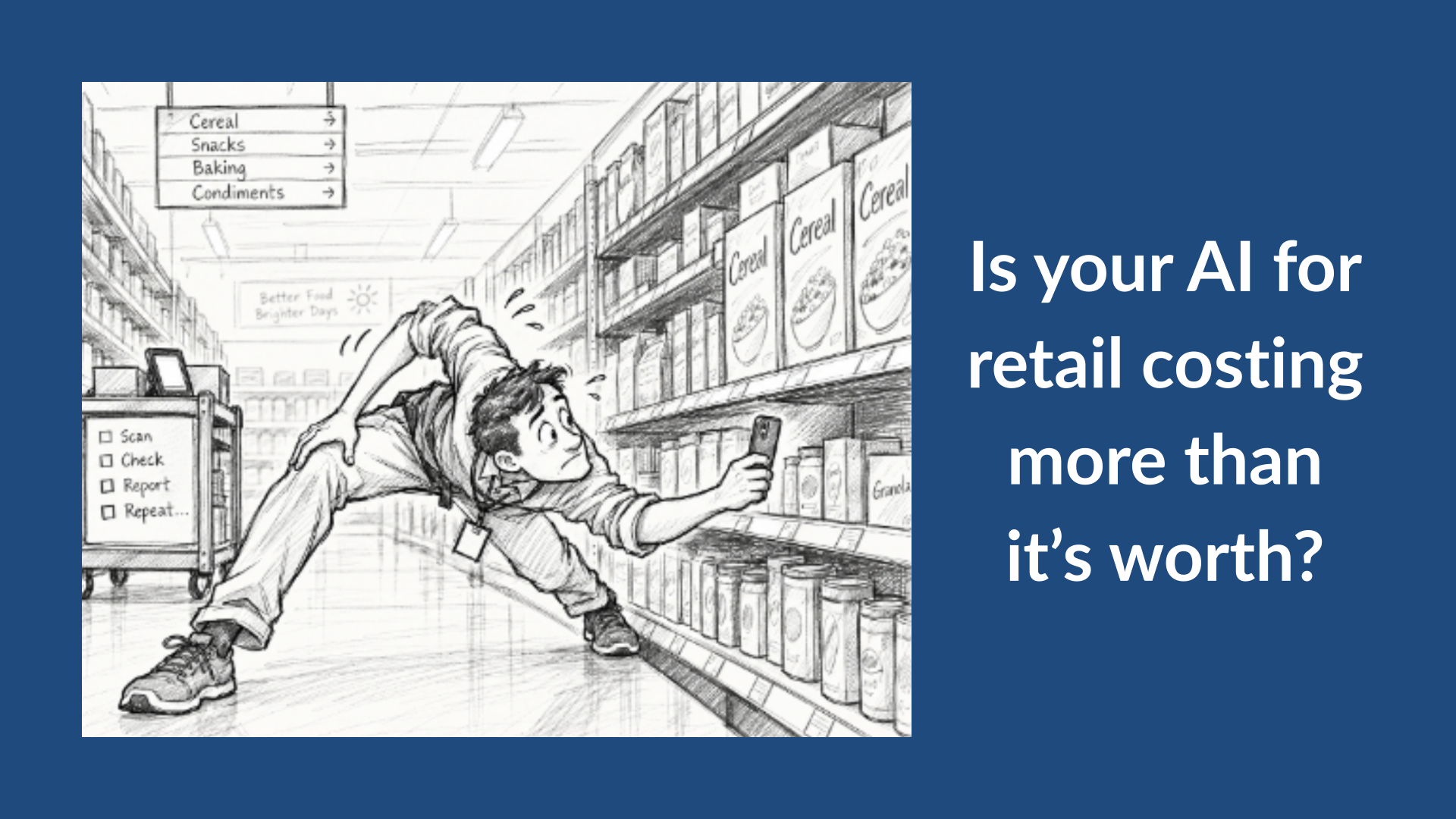
One important consideration for using AI at retail is understanding how much of a tax gets charged just to unlock its benefits.
The physical world, and the physical aisles and shelves of a retail store, need to be “seen” before AI can interpret, suggest, or fix anything. This is known as Physical AI and it requires AI vision to supply the input.
Earlier approaches to AI vision charged a tax for that input, or as we call it, the AI Use Tax. That is the extra time and effort it takes to feed the AI what it needs from the scene to extract value. The AI Use Tax occurs when the extra time and effort to collect the input for the AI is more than it is worth. This is not a technology cost. This is a labor cost, paid by whoever has to stop and collect the picture before the AI can do anything with it.
How early AI vision racked up the AI use tax
Picture what it actually takes for early computer vision to capture a scene one step and one photo at a time. A worker lines up the exact framing of a shelf, moves a few inches over with a bit of overlap, snaps another picture, and does it again, and again, down the length of the aisle. This process enables an older stitching technique to assemble each of those frames into a continuous panorama for the AI to process.
It is slow, tedious, and error prone. It costs real time and real money, on top of a job the frontline worker already had. Whether the tradeoff is worth it at all depends on who does the extra work, who pays for it, and who actually benefits from it upstream. That is the AI Use Tax, in practice.
Imagine asking an autonomous car to stop every few feet, hold still, while the AI carefully took a photo of its surroundings before it could take its next action. It would never leave the lot and nobody would accept that as viable. Retail workers shouldn’t have to accept it either.
How modern AI vision avoids the AI use tax
More modern AI vision techniques avoid the AI Use Tax by making the primary job faster and collecting the input for the AI at the same time, as a kind of data exhaust.
This is how Pensa AI works. On a quick walk down the aisle, with nothing more than the phone or handheld the frontline worker is already carrying, the AI takes in the motion and everything visible through the camera lens. That gives the AI all that it needs to see. From that alone, it builds a three-dimensional understanding of what is where, what is right and wrong about it — low inventory, bad placement, a promotion that never got set up, a planogram that drifted. No extra photos. No stopping to frame anything. The AI is the one doing the seeing; the worker just keeps walking.

What it means for field teams, and for headquarters
For field teams, this is where the tax disappears entirely. Automating up to 70% of the tedious, manual work of finding stockouts, out-of-compliance items, and pricing and promotion errors makes their job faster while they’re still in the store. It’s labor-negative from the very first use. There’s no tax at all; the savings show up immediately.
Today, the situation is far worse. Headquarters asks the field teams to slow their work down and collect extra data in the store, so that category management and customer insights teams get what they need: data collected for someone else’s benefit, not for the field team’s own execution tracking. That’s a double Use Tax: the field team pays the tax so teams at HQ can get the benefits. Or CPGs pay their merchandising broker more or a spot-auditing company to take photos and do the same extra work.
None of this should be happening anymore. Vision AI at retail, done properly, should speed up in-store work while it’s happening and, as an added benefit, hand that data over for free because the data for AI input happens as a byproduct of a workflow that’s already speeding up the field team’s job. One scan. No added work. Two teams getting what they need from it.
That is what it actually means to avoid the AI Use Tax, the hidden costs of letting AI see enough to help enough within the physical retail world.
Frequently asked questions
What is the “AI Use Tax” in retail?
It’s the extra time, effort, and cost required to collect the input an AI system needs before it can deliver value. For example, a worker having to take a series of carefully framed photos one at a time so software can stitch them into a scene. When that collection effort and processing costs more time than the AI gives back, it’s a tax on using AI, not a benefit of it.
Why did older AI vision approaches create so much extra work?
Older approaches relied on single photos taken one at a time to capture the full retail shelf, then those photos were stitched together into a panorama, which meant a worker had to stop, frame each shot precisely, move a short distance over, and repeat it down every aisle. That process is slow, error-prone, and adds a second job on top of the one the worker already had.
How does Pensa AI avoid the AI Use Tax?
Pensa AI views the aisle or store continuously as the worker walks down the aisle through the lens of a phone or handheld device a worker is already carrying, rather than a series of stitched photos. It builds a three-dimensional understanding of the shelf from that motion alone, so the data the AI needs shows up as a byproduct of a job that’s already done faster, not as separate work.
How does collecting data for headquarters create a “double” Use Tax for field teams?
When a field team has to slow down in the store to collect data mainly for teams at HQ, like category management or customer insights teams, rather than for their own execution tracking, that’s a second tax layered on top of the first: extra work for someone else’s benefit.
How much of the manual work does Pensa actually automate?
Up to 70% of the tedious, manual tasks involved in finding stockouts, out-of-compliance items, and pricing and promotion errors, based on Pensa’s deployments to date.
Go here to talk to us. Ask us how it’s working for our clients and how it can work for you.